
Molded Rubber Parts Manufacturer
High-quality molded rubber parts for industrial, automotive, and sealing applications. Custom rubber molded parts with precision tooling and flexible material options.
Molded Rubber Parts Manufacturer: Zero-Defect Precision, Delivered Faster.
Don’t assume that just because a supplier is local and closer to you, it’s worth paying high tooling and labor costs. If you encounter unpredictable shrinkage rates or unacceptable flash, and the supplier asks you to pay additional high modification fees without being able to implement timely improvements, you could suffer significant losses.
As a China-based direct OEM manufacturer of custom molded rubber parts, RiseUp specializes in producing a wide range of components, including seals, gaskets, and heavy-duty vibration dampers. We break through long lead-time bottlenecks by offering end-to-end solutions—from Design for Manufacturability (DFMA) review and in-house CNC mold machining to mass production and final delivery.
With advanced rubber-to-metal bonding technology and strict compliance with RMA A1/A2 molding tolerances, our OEM molded rubber parts ensure peak mechanical performance while significantly accelerating your time to market.

Engineering First: Design for Manufacturability (DFMA)
Most traditional custom rubber molding factories will only produce parts and tooling based on your 3D drawings, blindly starting mold steel cutting from the very beginning. In the end, due to uncontrollable processing factors, issues such as rubber shrinkage and severe flash on critical sealing surfaces often occur, delaying the launch of new products.
At RiseUp, we do much more than simply provide a quotation. Our professional engineering team conducts a full feasibility analysis of your drawings. Before machining P20 or H13 mold steel, our engineers perform a strict Design for Manufacturability (DFM/DFMA) review of your custom molded rubber parts.
Since rubber is an incompressible thermoset elastomer, its flow, cross-linking, and shrinkage behavior are completely different from rigid plastics. By identifying and optimizing design issues early in the process, we ensure that molded rubber parts can be successfully delivered in the very first trial run, eliminating the need for multiple mold revisions commonly seen with traditional suppliers and helping you avoid delays in your optimal market launch window.
1. Strategic Parting Lines & Flash Control: We precisely calculate where the upper and lower mold plates separate. By repositioning parting lines away from functional sealing lips onto non-critical surfaces, we ensure your O-rings and gaskets maintain a 100% leak-proof seal without compromising aesthetics.
2. Draft Angles & Undercuts: Complex geometries often get stuck in the mold cavity. We modify your 3D drawing (adding slight tapers and draft angles) so the vulcanized elastomer ejects smoothly without tearing, distortion, or the need for contaminating chemical mold-release sprays.
3. Air Trap Elimination & Shrinkage Control: Through advanced mold flow analysis, we design optimal gate locations and microscopic venting systems. This prevents trapped air pockets (voids) and allows us to precision-machine the mold to account for the exact shrink rate of your specified rubber compound.
4. Maximized Cavitation (Lowering Unit Cost): For high-volume rubber molding parts, the mold layout is everything. We engineer highly efficient multi-cavity tooling layouts that maximize our hydraulic press output, drastically reducing your per-unit cost while maintaining uniform pressure across every single part.
Molded Rubber Products
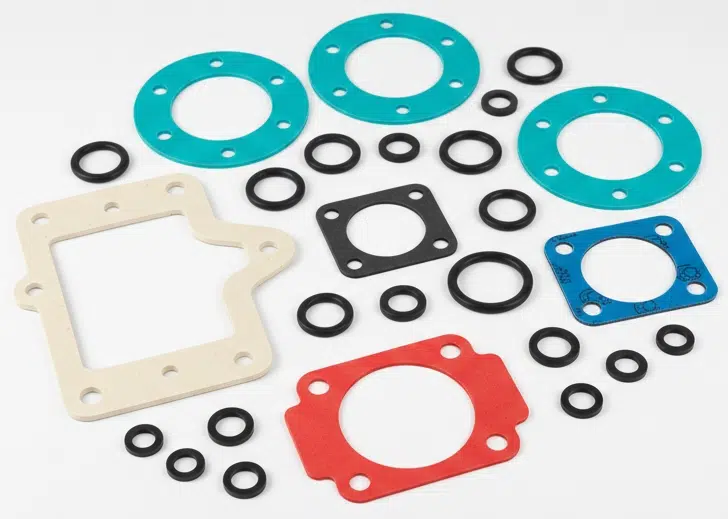
It is a flat static seal used to fill the gap between two flat surfaces. It can be customized into various shapes such as square, round, and more. It is mainly used for engine cylinder head gaskets, pipeline flange connections, and pump body sealing, making it suitable for low- to medium-pressure applications.
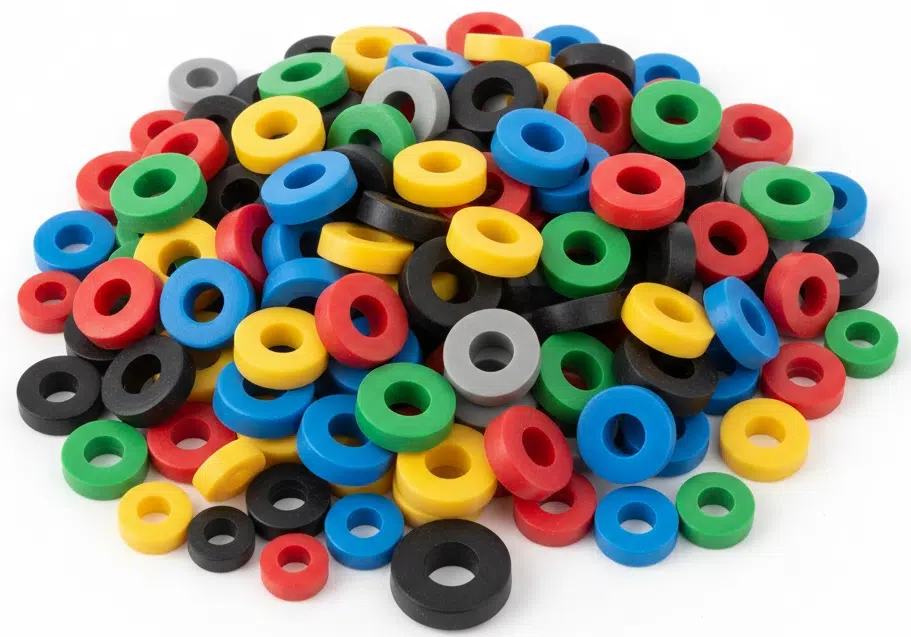
It is mainly used to protect wires and cables from being damaged by sharp edges, while also providing dustproofing and vibration-dampening functions. It can be customized into various shapes, such as round and I-shaped profiles. Typical applications include cable entry holes in electronic equipment enclosures, automotive wire harnesses passing through metal panels, and furniture cable holes. It is not suitable for high-pressure sealing applications.
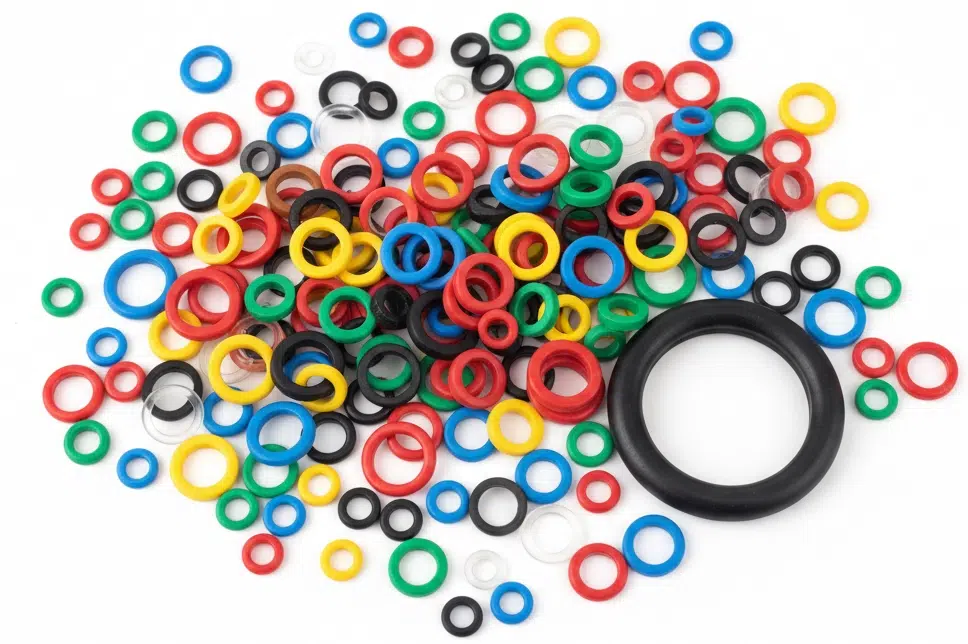
ts primary function is to prevent liquid and gas leakage. It typically features a round cross-section with a smooth surface. It is mainly used in hydraulic and pneumatic cylinder pistons, high-pressure water hose fittings, and aerospace pipeline sealing applications, making it suitable for dynamic high-pressure to ultra-high-pressure environments.
It serves as a conduit for transporting media, typically featuring a hollow circular cross-section. Common applications include laboratory hoses, automotive coolant hoses, garden water hoses, and medical tubing. It is suitable for low- to high-pressure environments. Its primary function is transportation rather than sealing.
The Right Process for Molding Rubber Parts: Compression, Transfer, or Injection
Our rubber molding parts manufacturing capabilities include compression molding, injection molding, and transfer molding processes.
We ensure stable quality, tight tolerances, and efficient production for global customers.
Different geometries, material viscosities, and production volumes require different manufacturing processes. As a rubber molding component supplier with 20 years of experience in R&D and manufacturing, we evaluate each customer’s actual needs as well as their future development plans. We then provide the optimal solution to improve efficiency and reduce costs, helping our customers enhance their competitiveness in the market.
1. Compression Molding (The Cost-Effective Workhorse)
How it works: Uncured rubber pre-forms (measured precisely by weight) are placed directly into the open, heated mold cavity and compressed under massive hydraulic pressure.
Best For: Large, bulky components (like heavy vibration mounts), low-to-medium production volumes, and high-durometer (stiff) elastomer compounds.
The Advantage: The lowest initial tooling costs and the fastest setup times. Highly economical for simple shapes.


2. Transfer Molding (For Complex Geometries & Overmolding)
How it works: The raw rubber is loaded into a separate chamber (the pot) above the mold. A piston then forces the material through a sprue system into the already-closed heated cavity.
Best For: Intricate shapes, fragile thin walls, and Rubber-to-Metal Bonding. Because the mold is completely closed before the rubber enters, metal inserts remain perfectly secured in place.
The Advantage: Achieves tighter dimensional tolerances and produces significantly less flash compared to traditional compression molding.
3. Rubber Injection Molding (High-Speed Precision)
How it works: A fully automated process. Pre-heated, highly viscous rubber is injected under extreme pressure directly into the closed mold cavities using a screw-feeder mechanism.
Best For: Micro-molding, extreme dimensional precision (RMA A1 class), and high-volume mass production runs of rubber molding parts (hundreds of thousands of units).
The Advantage: The absolute lowest unit price, exceptionally fast cycle times, and virtually zero material waste. (Note: Requires a higher initial investment in CNC tooling).

Beyond Basic Manufacturing: Overmolding & Flawless Finishing
Standard compression molding is only the baseline. The key difference between top-tier custom rubber molding manufacturers and ordinary suppliers lies in their mastery of critical secondary processing techniques.
We position ourselves as a solution provider of ready-to-assemble finished components, specifically engineered to withstand extreme mechanical stress.

Precision Rubber-to-Metal Bonding (Overmolding)
For shock absorbers, engine mounts, and heavy-duty structural seals, rubber must be permanently bonded to a rigid substrate. What we do is not simply “gluing” parts together. We chemically bond elastomers to steel, aluminum, brass, and high-temperature engineering plastics such as PEEK or nylon.
Through rigorous substrate surface treatments such as sandblasting for roughening and ultrasonic cleaning, combined with the precise application of specialized heat-activated primer adhesives, we achieve molecular-level bonding during the vulcanization process.
The final result is that under extreme tensile stress, the rubber body of your custom molded parts may tear, but the chemical bonding layer will remain completely intact, ensuring overall structural stability and durability.
Liquid Nitrogen Cryogenic Deflashing (Zero-Flash Guaranteed)

Some ordinary suppliers or small workshops, in order to reduce costs, rely on manual blade trimming by workers. This results in very slow production speed, uneven edges, and damage to extremely critical tolerances, ultimately leading to sealing failures.
To ensure our OEM molded rubber parts meet strict RMA A1/A2 sealing standards, we use advanced automated cryogenic deflashing technology. After vulcanization, the parts are tumbled inside a liquid nitrogen–controlled cryogenic chamber, where only the paper-thin flash is frozen until it becomes brittle. High-strength polycarbonate media is then used to safely break away and remove the flash.
This process delivers 100% clean, flash-free edges that are fully suitable for automated assembly, while causing zero damage to the core physical properties of the parts. This is a standard that ordinary rubber molding suppliers simply cannot achieve.
Specifying the Right Elastomer for Harsh Environments
Different materials provide unique properties such as Automotive sealing systems,Industrial equipment,Electrical components,Medical devices,Fluid control systems applications
If a polymer degrades, swells, or cracks under operating pressure, even a perfectly dimensioned and visually flawless part becomes useless. For custom molded rubber components—especially static seals and dynamic gaskets—compression set (the ability of an elastomer to recover its original thickness after prolonged compression) is a critical performance indicator.
As a leading molded rubber parts manufacturer, we don’t just rely on off-the-shelf standard materials. We are capable of formulating custom-compounded elastomers to meet the specific requirements of your industry:
🌡️ Extreme Temperature Flexibility & High-Purity: Silicone molded rubber parts (VMQ). Maintains incredible elasticity and resists compression set from -60°C up to +220°C. For medical and food-grade applications, we specify Platinum-Cured Silicone, which is extremely low-outgassing, biocompatible, and withstands repeated Autoclave sterilization.
⚙️ High Abrasion & Cost-Efficiency: SBR molded rubber parts. An excellent general-purpose elastomer offering outstanding abrasion resistance and durability. The go-to choice for heavy-duty industrial pads, custom bumpers, and non-oil sealing applications where cost-effectiveness is a priority.
🔥 Extreme Heat & Harsh Chemicals: FKM molded rubber parts . Engineered to retain sealing integrity in aggressive aviation fuels, concentrated acids, and extreme operating temperatures up to +250°C.
🌦️ Dynamic Flex & Weathering: EPDM molded rubber parts. Offers unmatched resistance to ozone, UV degradation, and steam. The absolute industry standard for outdoor electrical enclosures and automotive weather seals.
💥 Vibration Isolation & Tear Strength: Nitrile (NBR) molded rubber parts. Ideal for engine mounts, while NBR is the ultimate choice for oil-resistant molding rubber parts.
Why Choose RISEUP
1.20+ years rubber molding experience in China
2.OEM molded rubber parts service
3.In-house mold design and production,ensuring zero-defect parts
4.Passed ISO9001,ROHS,Reach,FDA,LFGB certification
5.We are High Tech Company In China
6.We are a direct China factory, eliminating middleman markups


Custom Rubber Molded Parts FAQs
Prototype molds start at just $150-$300 USD. High-cavity production molds typically range from $1,000-$3,000 USD. Rubber tooling is significantly cheaper than plastic injection molding.
7 to 10 working days for CNC mold machining and First Article Samples (FAS). Mass production takes 2 to 3 weeks after sample approval.
We are flexible. We support low-volume prototype runs (hundreds of pieces) and easily scale to high-volume automated production (millions of pieces).
For the fastest DFMA review and quoting, please upload 3D models in .STEP, .IGES, .X_T, or .SLDPRT formats.
Yes. We custom-compound materials to hit exact Shore A durometers and can match any Pantone or RAL color for your custom rubber molded parts.
We routinely manufacture to RMA A2 (Precision) for commercial applications and RMA A1 (High Precision) for critical components.
Absolutely. We provide First Article Inspection (FAI) reports, material certifications, and Level 1-3 PPAP documentation for automotive and OEM clients.
MOQ 500 pcs, Accept Customization for Small Order. Design Products as Your Idea.
Releted Products
Package Method


"Take The Efficient Booster For Your Business Now "

Alan Chen
Product Sales Manager & Rubber Specialist at RISEUP
