
Custom Neoprene Rubber Grommets for Cable and Panel Protection
Protect wires, cables, tubes and panel openings with custom neoprene rubber grommets designed for abrasion protection, vibration reduction and secure installation. Neoprene, also called CR or chloroprene rubber, provides a balanced direction for changing outdoor and industrial environments
- Protect cables from sharp metal and plastic panel edges
- Reduce repeated rubbing, vibration, rattling and installation damage
- Match a worn or discontinued grommet from a physical sample
- Develop non-standard inner diameters, outer dimensions and groove profiles
- Review neoprene compound requirements for weather, ozone, moisture or industrial exposure
- Confirm a prototype sample before production tooling
What Is a Neoprene Rubber Grommet?
A neoprene rubber grommet is a molded protective component made from chloroprene rubber, also known as CR or neoprene. It is installed in a hole, slot or opening in a metal, plastic or composite panel to protect wires, cables, tubes and other components from sharp edges, abrasion and movement.
The grommet’s outer groove locks into the panel opening, while the inner opening creates a smoother passage for the cable or tube. This structure helps reduce jacket damage, vibration noise, rattling and repeated wear during assembly or equipment operation.
Neoprene is selected when a project needs a balanced combination of flexibility, abrasion resistance, resilience, weathering resistance and ozone resistance. It is often considered for outdoor electrical enclosures, industrial equipment, automotive components, machinery housings and other applications exposed to changing environmental conditions.
Neoprene is not automatically the best choice for every chemical or temperature condition. Continuous contact with fuel, oil, aggressive chemicals or elevated temperatures should be reviewed before production. Depending on the operating environment, NBR, EPDM, FKM or silicone may be a more appropriate material direction
Neoprene Grommet Selection Factors
The correct neoprene grommet should be selected according to:
- Panel hole diameter
- Panel thickness
- Cable or tube diameter
- Groove width and retention requirements
- Required Shore A hardness
- Exposure to moisture, ozone, sunlight, oil or chemicals
- Installation method and expected movemen
Why Choose Neoprene Rubber Grommets?
Neoprene rubber grommets are selected when a project needs more than basic edge protection but does not require a highly specialized extreme-performance compound. Neoprene provides a balanced material direction for cable and panel protection in changing outdoor and industrial environments

Balanced Weathering and Ozone Performance
Neoprene can be considered for equipment exposed to changing weather, moisture and ozone. It helps maintain useful flexibility and protective contact when the grommet is installed in outdoor electrical enclosures, machinery housings or vehicle components.
For continuous, severe UV exposure or long-term outdoor weathering, the actual environment should be reviewed and EPDM grommet may be considered as an alternative.
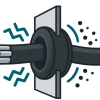
Protection During Vibration and Movement
Cables and tubes may move against panel openings during equipment operation, transportation or assembly. A properly designed neoprene grommet creates a flexible barrier between the cable and the rigid panel edge, helping reduce rubbing, rattling and jacket damage.
The final result depends on the cable diameter, panel thickness, groove design, hardness and required retention force

Flexible Fit for Custom Assemblies
Neoprene grommets can be developed with custom inner diameters, outer diameters, groove widths, flange profiles and mounting features. This allows the part to match the actual panel opening instead of forcing a standard grommet into an unsuitable fit

A Practical Choice for Mixed Environmental Conditions
Some equipment experiences moisture, moderate sunlight, vibration and temperature changes without continuous exposure to oil or aggressive chemicals. In these cases, neoprene can provide a practical balance between environmental protection, flexibility and molded production
Neoprene Is Not a Universal Material
Material selection should follow the actual operating environment
| Operating condition | Material direction to review |
|---|---|
| General abrasion and cost-sensitive protection | SBR |
| Oil, fuel or grease exposure | NBR |
| Long-term outdoor, ozone and UV exposure | EPDM |
| High temperature, fuel or aggressive chemicals | FKM |
| Changing outdoor and industrial conditions | Neoprene |
| Very wide temperature range or soft contact | Silicone |
Where Are Neoprene Rubber Grommets Used?
Neoprene rubber grommets are used when cables, wires, tubes or small components pass through a panel opening and the assembly may experience moisture, ozone, weather changes, vibration or repeated movement
Neoprene rubber grommets protecting cables in an outdoor electrical enclosure](https://riseuprubber.com/wp-content/uploads/elementor/thumbs/application-outdoor-electrical-enclosure-real-ru3u085hdwr00ikd2h0lhl5vr382u4qqunihjhiio8.png "application-outdoor-electrical-enclosure-real")
Outdoor Electrical Enclosure
Neoprene grommets protect wires passing through outdoor control cabinets, junction boxes and electrical enclosures. They help create a flexible barrier between the cable jacket and the metal or plastic panel opening

Industrial Machinery and Control Panel
Machinery often combines vibration, cable movement, painted metal panels and repeated service access. Custom neoprene grommets help protect wiring where cables enter machine frames and control panels.
Neoprene rubber grommet protecting automotive wiring through a vehicle panel](https://riseuprubber.com/wp-content/uploads/2026/09/application-automotive-wire-routing-real.png.webp)
Automotive and Mobility Equipment
Automotive wiring, motorcycle harnesses and mobility equipment may require flexible protection around body panels, brackets and equipment housings. The grommet design should be matched to the panel thickness, cable bundle and expected movemen

Marine and Moisture-Exposed Equipment
Neoprene grommets can be evaluated for equipment exposed to humidity, splashing water and changing outdoor conditions. Actual sealing requirements, immersion conditions and material compatibility should be reviewed before production
Neoprene rubber grommet protecting cables in battery and power equipment](https://riseuprubber.com/wp-content/uploads/2026/09/application-battery-power-equipment-real.png.webp)
Battery, Power and Energy Equipment
Battery cabinets, charging equipment and power-control housings often require organized cable routing through coated metal or plastic panels. Custom neoprene grommets can be developed around cable diameter, panel thickness and assembly access.
Neoprene rubber grommet protecting internal wires inside an equipment housing](https://riseuprubber.com/wp-content/uploads/2026/09/application-equipment-housing-real.png.webp)
Equipment Housings and Appliance Assemblie
Neoprene grommets can protect internal wires and tubes passing through appliance housings, instrument panels and equipment covers. The design can be adjusted for plastic or metal openings and for the required installation fee
Replacement neoprene rubber grommet matched to a worn sample for MRO repair](https://riseuprubber.com/wp-content/uploads/2026/09/application-replacement-repair-mro-real.png.webp)
Replacement, Repair and MRO Projects
Maintenance teams may have only a worn, cracked or discontinued grommet without an original drawing. A physical sample can be reviewed to develop a replacement part and confirm fit before production
Custom Neoprene Rubber Grommets Made to Your Drawing or Sample
Standard grommets may not match your panel thickness, cable diameter, groove profile or installation method. Custom neoprene rubber grommets can be developed around the actual assembly requirements instead of forcing the application to fit an off-the-shelf par
Custom Dimensions
We can review and develop:
- Panel-hole diameter
- Cable or tube opening
- Outer diameter
- Wall thickness
- Groove width and depth
- Flange diameter and thickness
- Retention features
- Sealing or dust-protection sections
Custom Shapes and Profiles
Neoprene grommets can be developed in round, oval, rectangular, square, D-shaped, tapered, blind or application-specific profiles. The final shape should be based on the panel opening, installation direction and required retention force.
Custom Hardness and CR Formulation
Hardness can be selected according to installation feel, panel grip, cable movement and retention requirements. The CR compound can be reviewed for the project’s moisture, ozone, weathering, abrasion and moderate industrial exposure.
The correct formulation should be confirmed through sample evaluation and actual application conditions. A harder compound is not automatically better if the part must flex around a cable or snap into a panel opening.
Custom Colors
The default appearance depends on the selected CR compound. Custom colors can be reviewed using a Pantone reference or a physical color sample. Gray, red, blue, green and other project-specific colors may be developed when the color requirement is confirmed.
Development from a Physical Sample
If you do not have a drawing, send us an existing or worn grommet. We can review its dimensions, geometry, installation condition and material feel, then develop a replacement sample for approval.
Prototype Tooling Before Production Tooling
For a custom project, we can develop prototype tooling first and produce initial samples for fit and function review. After the sample is approved, production tooling can be manufactured for repeat or larger-volume production. This staged process helps reduce the risk of committing to incorrect production tooling
What Information Do We Need to Develop Your Custom Neoprene Grommet?
A custom neoprene rubber grommet should be designed around the actual panel, cable and operating environment. The more accurate the initial information, the easier it is to confirm fit, retention and material suitability before tooling

1. Panel Opening
Please provide the panel-hole diameter, hole shape and opening location. For non-round holes, include the length, width, corner radius and orientation.
2. Panel Thickness
Panel thickness determines the groove width and how securely the grommet will seat in the opening. If the panel has a coating, flange or stepped structure, include those details.
3. Cable or Tube Dimensions
Provide the outside diameter, bundle diameter or cross-section of the cable, wire or tube passing through the grommet. If the cable moves during operation, describe the movement direction and frequency.
4. Grommet Geometry
A drawing or sample should show the inner diameter, outer diameter, wall thickness, groove width, flange dimensions, sealing lip and any retention features.
5. Hardness and Installation Feel
Tell us whether the grommet needs to be soft and flexible, firm and highly retained, or balanced for repeated installation. Hardness should be selected together with the cable diameter, panel thickness and groove design.
6. Environmental Conditions
Please identify exposure to:
- Moisture and humidity
- Ozone and changing outdoor conditions
- Sunlight and UV
- Oil, fuel or grease
- Chemicals
- Temperature changes
- Vibration and repeated movement
This information helps determine whether Neoprene is appropriate or whether NBR, EPDM, FKM, SBR or silicone should also be reviewed.
7. Color and Identification
Provide the required color, Pantone reference or physical color sample. Part numbers, bag labels and packaging requirements can also be confirmed during development.
8. Drawing or Physical Sample
A 2D drawing, 3D file, dimensional sketch or physical sample can be used to begin the review. If the original drawing is unavailable, a worn sample can still help us evaluate the replacement structure.
Development Information Checklis
| Information | Why it matters |
|---|---|
| Panel-hole diameter and shape | Determines the outside fit |
| Panel thickness | Determines groove width and retention |
| Cable or tube diameter | Determines the inner opening |
| Groove and flange dimensions | Controls seating and pull-out resistance |
| Hardness requirement | Affects flexibility and installation feel |
| Environmental exposure | Supports material and compound review |
| Color requirement | Supports appearance matching |
| Drawing or physical sample | Provides the basis for development |
| Installation and movement details | Helps confirm long-term fit |
How Does Neoprene Compare with Other Grommet Materials?
The best grommet material depends on the actual exposure conditions, not only on the product name or appearance. Neoprene is often considered a balanced option for changing outdoor and industrial environments, while other compounds may be more suitable for specific oil, temperature, weather or cost requirements
| Material | Main strength | Typical grommet direction | When to review another material |
|---|---|---|---|
| Neoprene / CR | Balanced flexibility, abrasion resistance, weathering and ozone performance | Outdoor electrical enclosures, industrial panels, automotive and mixed environments | Review NBR or FKM for continuous oil or fuel; review EPDM for severe long-term outdoor exposure |
| NBR / Buna-N | Oil, fuel and grease resistance | Oil-exposed machinery, engine-related assemblies and fluid-handling equipment | Review Neoprene, EPDM or SBR when oil resistance is not the primary requirement |
| EPDM | Weathering, ozone, sunlight and water resistance | Outdoor equipment, exposed enclosures and long-term weathering applications | Review NBR for oil or fuel; review FKM for high-temperature chemical exposure |
| FKM / Viton | High-temperature and chemical or fuel resistance | Severe temperature, fuel and aggressive chemical environments | Review Neoprene or SBR when extreme resistance is not required |
| SBR | General abrasion resistance and cost-conscious molding | Indoor equipment, general cable protection and moderate-duty applications | Review Neoprene or EPDM when outdoor or ozone exposure is important |
| Silicone | Wide temperature range and soft flexibility | Temperature-sensitive equipment and soft-contact applications | Review Neoprene, NBR or EPDM when silicone performance is not required |
Why Neoprene May Be the Right Direction
Neoprene is worth reviewing when the application combines several moderate requirements:
- The grommet must remain flexible around a moving cable
- The assembly may experience moisture or changing weather
- Ozone exposure is possible
- General abrasion protection is required
- The equipment is industrial, electrical, automotive or outdoor
- The project does not require continuous fuel, oil or extreme-temperature resistance
Material Selection Should Be Application-Based
No rubber compound should be selected from a comparison table alone. Final selection should consider:
- Actual contact media
- Temperature range
- Exposure duration
- Sunlight and ozone intensity
- Cable movement
- Panel material and thickness
- Required hardness and retention
- Installation method
- Required service lif
Neoprene Grommet Mold Design Based on CR Compound and Hardness
A custom Neoprene rubber grommet should be designed by considering the CR compound, Shore A hardness and product geometry together. The material is not only selected for the finished part; it also affects groove filling, demolding, parting-line control, installation force and long-term panel retention
How CR Hardness Affects the Grommet
The selected hardness can influence:
- Panel retention force
- Cable installation force
- Groove engagement
- Flexibility around the cable
- Resistance to deformation
- Demolding stress
- Parting-line appearance
- Dimensional recovery after molding
A harder compound may increase retention, but it can also make deep grooves, thin lips or undercut profiles more difficult to demold. A softer compound may improve flexibility, but it may require additional review for pull-out resistance and dimensional stability.
Neoprene-Specific Mold Design Review
For a Neoprene grommet with deep grooves, thin sealing lips or undercuts, the tooling design should be reviewed before production. Depending on the geometry and compound hardness, the tooling team may evaluate:
- Conventional compression molding
- Middle-plate mold structures
- Moving-core solutions
- Controlled parting-line placement
- Flash-reduction features
- Demolding support for undercut profiles
The correct tooling direction depends on the actual drawing, sample, hardness and installation requirements. It should not be selected only from a similar product photo.
Prototype Tooling Before Production Tooling
We recommend developing prototype tooling first for custom Neoprene grommets. Initial samples can be used to validate:
- CR compound direction
- Shore A hardness
- Groove engagement
- Cable opening
- Panel fit
- Installation force
- Parting-line location
- Flash and deformation
- Surface appearance
- Color consistency
After the sample is approved, production tooling can be manufactured for repeat or larger-volume production. This staged process helps reduce the risk of committing to incorrect tooling before the material and geometry are fully validated.
Neoprene Grommet Process Checks
| Process checkpoint | What to confirm |
|---|---|
| Compound review | Is the CR formulation suitable for the intended exposure? |
| Hardness review | Does the hardness balance flexibility and retention? |
| Moldability review | Can the groove, lip and undercut fill correctly? |
| Demolding review | Can the part be removed without tearing or permanent deformation? |
| Parting-line review | Is the parting line positioned away from critical sealing or seating areas? |
| Sample fit review | Does the grommet install correctly in the actual panel? |
| Production approval | Has the sample been approved before production tooling? |
Frequently Asked Questions
Neoprene is the common trade name for chloroprene rubber. CR is the common abbreviation used for chloroprene rubber. The actual formulation and performance should still be confirmed for the application
They can be considered for changing outdoor conditions, moisture and ozone exposure. Long-term severe sunlight, continuous oil contact, high temperature or aggressive chemicals should be reviewed before production
Yes. Custom dimensions, shapes, groove profiles, hardness, colors and mounting features can be developed from a drawing, dimensional sketch or physical sample
Yes. An existing or worn part can be reviewed to develop a replacement sample. The replacement should be checked for dimensions, panel fit, cable opening, hardness and installation feel
Yes. Prototype tooling and initial samples can be developed first. After the sample is approved, production tooling can be manufactured for repeat production
Please send a drawing, 3D file, dimensional sketch or physical sample. Include panel thickness, hole dimensions, cable diameter, hardness, color, operating environment and estimated requirements when available.
Send your drawing, sample or product concept. We will review the dimensions, CR material direction, moldability, sample-development route and information required for the next step
MOQ 500 pcs, Accept Customization for Small Order. Design Products as Your Idea.
Related Products
Package Method


"Take The Efficient Booster For Your Business Now "

Alan Chen
Product Sales Manager & Rubber Specialist at RISEUP
