
Fluorosilicone Rubber Tubing For Fuel Contact And High-Temperature Systems
When standard tubing cannot meet fuel compatibility, temperature changes or equipment dimensions, a custom fluorosilicone tubing review helps reduce selection and installation risk
1. Fuel-Contact Material Selection
2. -60°C to 200°C Working Range
3. Blue Tubing for Identification
4. Custom Dimensions from Drawing or Sample
What Is Fluorosilicone Rubber Tubing?
Fluorosilicone rubber tubing is a flexible elastomeric tube made from fluorosilicone rubber, also known as FVMQ. It creates a controlled passage for fuel, oil-based fluids, gases or vapors while separating the transported medium from surrounding components.
Compared with general-purpose silicone tubing, it is considered when the application requires a balanced combination of flexibility, temperature resistance and fuel or fluid compatibility. Final performance depends on compound formulation, hardness, wall thickness, tube geometry and operating conditions
How It Performs Its Function
Fluorosilicone rubber tubing works by forming a continuous and flexible connection between system components. The inner bore carries the selected medium, while the rubber wall provides separation between the medium and nearby equipment.
The tube can be routed through equipment and secured with fittings, clamps or connectors. Its flexibility helps accommodate normal movement and vibration, while the selected wall thickness supports the required pressure and helps reduce kinking or collapse.
For fuel-contact systems, the fluorosilicone compound forms the material barrier between the transported medium and the tube wall. Fuel type, temperature, pressure, movement and connection method should therefore be reviewed together before final approval
Four Functional Roles
1. Fluid or Gas Conveyance
Provides a controlled passage for fuel, oil-based fluids, gases or vapors.
2. Media Isolation
Separates the transported medium from surrounding components and equipment surfaces.
3. Flexible Equipment Connection
Connects components that may have different positions, movement or vibration during operation.
4. Environmental Protection
When correctly designed and installed, helps reduce contamination, abrasion and contact damage around the tube and connected components
Key Selection Factors
| Selection Factor | Why It Matters |
|---|---|
| Inner diameter | Controls the flow passage and fitting connection |
| Outer diameter | Determines clamp, housing and installation clearance |
| Wall thickness | Influences pressure support, flexibility and deformation resistance |
| Fuel or fluid type | Determines compound compatibility with the actual medium |
| Working temperature | Affects flexibility, aging and dimensional stability |
| Bend radius | Helps reduce kinking and excessive wall deformation |
| Pressure and movement | Determines whether structural review is required |
| Color requirement | Supports line identification and visual management |

Why Choose Fluorosilicone Rubber Tubing for Fuel Contact?
Fluorosilicone rubber tubing is selected when a system needs more than general flexibility and temperature resistance. The tubing must also maintain a reliable material barrier when exposed to fuel or oil-based fluids. Compared with general-purpose silicone tubing, fluorosilicone offers a more application-focused option for fuel-contact conditions, subject to compound and medium compatibility review
1. Fuel Contact Requires More Than Temperature Resistance
General silicone tubing is often valued for its flexibility and wide temperature capability, but temperature resistance alone does not confirm suitability for fuel service. Fuel exposure can affect swelling, stiffness, mass change, surface condition and long-term dimensional stability.
Fluorosilicone tubing is considered when the application combines fuel contact with a requirement for flexible routing and controlled tube geometry. The actual fuel, additives, exposure time and operating temperature should be reviewed before the compound is approve
2. The Material Barrier Helps Protect the Fluid Path
The tube wall is the separation layer between the transported fuel and surrounding equipment. A suitable fluorosilicone formulation can help maintain the intended wall structure and connection condition during the specified service environment.
This is important in fuel lines, engine-adjacent routing and equipment assemblies where leakage, tube deformation or loss of connection security could lead to maintenance problems. The final result still depends on wall thickness, pressure, bend radius, fittings and installation support
3. When the Added Material Value Is Justified
Fluorosilicone tubing is more valuable when fuel exposure is a confirmed operating condition and the cost of premature replacement, leakage investigation or equipment downtime is significant. It may not be the most economical choice for clean-air, water-only or non-fuel applications where general silicone or another elastomer already meets the requirements.
For projects requiring high-temperature fluorosilicone rubber tubing for fuels, the selected compound should be checked against the actual temperature cycle and fuel type. Material selection should be based on service risk and compatibility, not on temperature rating alone

Custom Fluorosilicone Rubber Tubing for Your Assembly
A custom fluorosilicone rubber tubing project should be developed around the actual equipment connection, fuel exposure and installation space. Customization is not limited to changing the tube length. Inner diameter, outer diameter, wall thickness, bend radius, compound formulation and color may all affect the final result
1. Inner Diameter and Outer Diameter
The inner diameter should match the required flow passage and connection method. The outer diameter must allow enough clearance for clamps, fittings, housings and nearby components.
We review both dimensions together because changing the inner diameter without checking the outer diameter can affect wall thickness, flexibility and installation spac
2. Wall Thickness and Pressure Support
Wall thickness influences the tube’s pressure support, flexibility and resistance to collapse. A thinner wall may help with bending and routing, while a thicker wall may provide additional structural support where pressure, clamping or abrasion is a concern.
The final wall thickness should be selected according to the actual pressure, bend radius, temperature cycle, connection design and available installation space
3. Compound Formulation for Fuel Contact
For fuel-contact applications, the fluorosilicone compound should be considered together with the actual fuel, additives, exposure time and temperature. If the project requires high-temperature fluorosilicone rubber tubing for fuels, the formulation must be reviewed against the complete operating cycle rather than temperature alone.
This review helps determine whether the selected compound is appropriate for the intended fluid path and service condition
4. Blue Color and Visual Identificatio
We can produce blue fluorosilicone tubing when the system requires color coding, line identification or easier maintenance management. For fuel-resistant blue fluorosilicone rubber tubing, color selection and fuel-contact formulation should be confirmed together before sampling
5. Bend Radius and Connection Geometry
The tube may need to pass around equipment, connect offset ports or accommodate normal vibration. We review the required bend radius, straight sections, connection ends and clamping positions to reduce excessive bending, kinking and connection stress
Process Control for Custom Fluorosilicone Rubber Tubing
Custom fluorosilicone rubber tubing requires control of both the rubber compound and the tube profile. A stable result depends on the relationship between formulation, inner diameter, outer diameter, wall thickness, curing condition and final application
1. Compound Preparation for the Intended Medium
The fluorosilicone compound is reviewed according to the actual fuel, oil-based fluid, temperature range and exposure conditions. For fuel-contact projects, the compound selection should be confirmed before the tube profile is finalized.
This prevents the tube geometry from being approved before the material’s service conditions are properly understood
2. Profile and Dimension Developmen
The tube profile is developed around the required inner diameter, outer diameter, wall thickness, length and bend behavior. If the product has special ends, changing wall thickness or a non-standard profile, the forming route should be reviewed before production.
The purpose is to keep the material and geometry working together rather than treating the tubing as a simple hollow rubber part
3. Curing and Dimensional Stability
The curing condition affects the final hardness, elasticity, surface condition and dimensional stability of the tubing. After forming and curing, the tube can be reviewed for inner diameter, outer diameter, wall thickness, appearance and cut-end quality.
The inspection method should reflect the customer’s actual connection and installation requirements
4. Sample Confirmation Before Repeat Production
For a custom Rubber Parts project, we can prepare sample tubing based on the confirmed drawing, sample or dimensional requirements. The customer can then check the tube in the actual assembly, including routing, bending, connection, clearance and fuel-contact conditions.
If the sample requires adjustment, the compound, profile or dimensions can be reviewed before repeat production is arrange
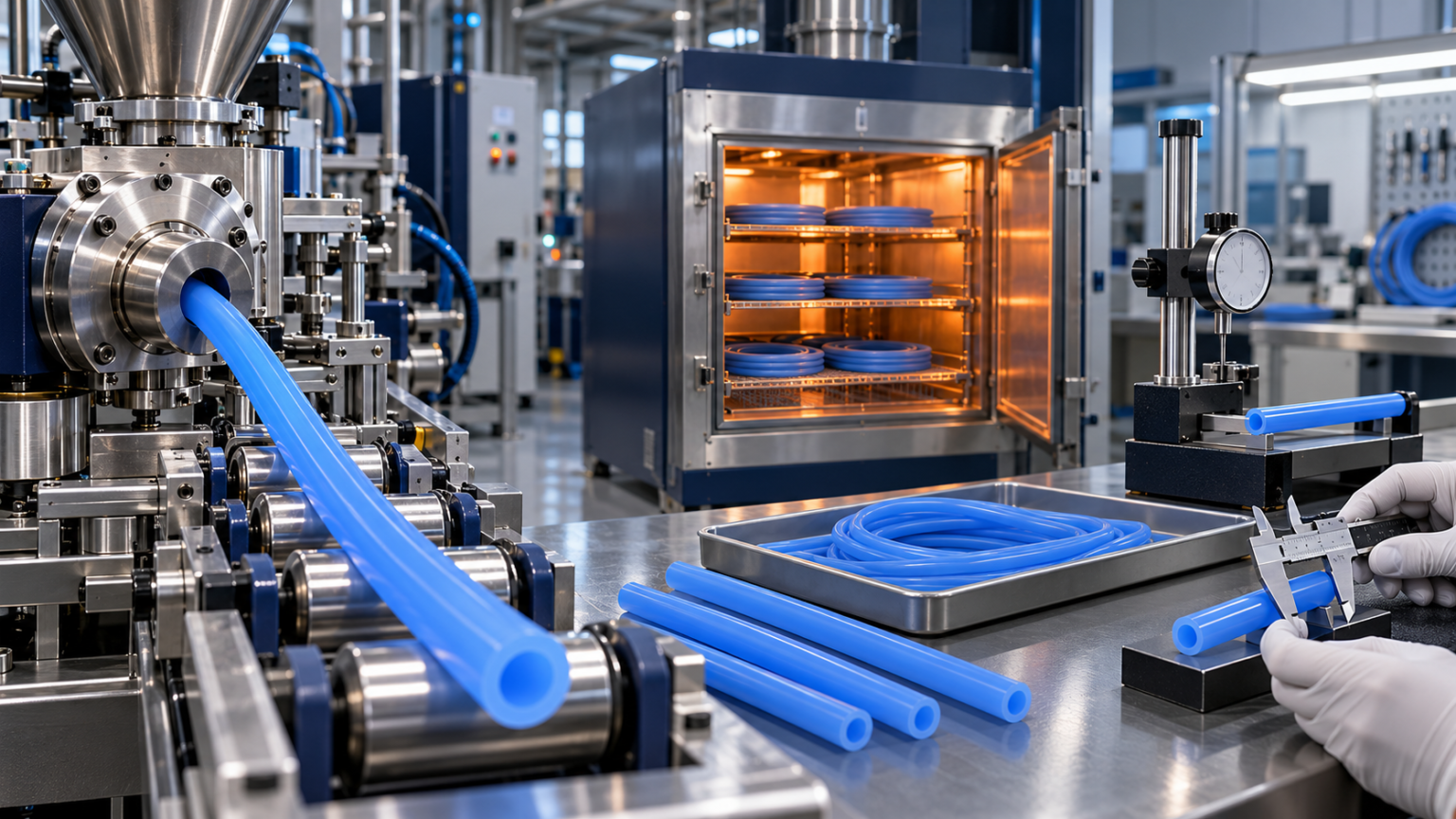
Fuel Contact Applications for Fluorosilicone Rubber Tubing
Fluorosilicone rubber tubing can be considered for fuel-contact systems where the tube must transport or isolate fuel while remaining flexible around equipment. The actual fuel, pressure, temperature, movement and connection method should be reviewed before final material approval

Fuel Supply and Return Lines
Fluorosilicone rubber tubing may be used for fuel supply or return routing when the selected compound is compatible with the actual fuel and additives. The tube helps create a flexible connection between the fuel source, pump and receiving component.
During design, confirm the inner diameter, pressure, bend radius and clamp position. Avoid tight bends or unsupported sections that could cause kinking, flattening or stress at the connection

Engine-Adjacent Fuel Routing
Engine-adjacent routing may expose the tubing to fuel contact, vibration and changing temperatures at the same time. High-temperature fluorosilicone rubber tubing for fuels can be considered when the compound and temperature cycle have been reviewed for the intended location.
The design should include sufficient clearance from hot surfaces, moving parts and sharp edges. Clamps should support the tube without excessive compression or local deformation

Fuel Equipment and Enclosure Connections
Fuel equipment may require flexible tubing between a reservoir, valve, sensor, pump or enclosed assembly. Custom fluorosilicone tubing can help accommodate offset ports and limited installation space when the dimensions are developed around the actual equipment.
Before installation, check the tube’s outer diameter, connector compatibility, bend radius and clearance inside the enclosure. Avoid forcing the tube into position because installation stress can affect long-term sealing.

Fuel Testing and Service Assemblies
Fuel testing or service equipment may require tubing that can be identified by color and replaced according to a defined dimensional requirement. Fuel-resistant blue fluorosilicone rubber tubing can support visual line identification when the color and compound are confirmed together.
For service assemblies, review the connection method, expected replacement frequency, cleaning procedure and exposure time. The tubing should be checked for surface damage, deformation and connection security during maintenance.
Confirm Fuel Compatibility and Temperature Before Production
Fluorosilicone rubber tubing should be selected according to the actual fuel or fluid, not by material name alone. The confirmed working range for this product is -60°C to 200°C, but the final service limit depends on the compound formulation, fuel composition, pressure, exposure duration and tube structure
Fuel and Fluid Compatibility Review
Different fuels and fluids may contain different additives, solvents or chemical components. These factors can affect swelling, hardness, flexibility, surface condition and long-term dimensional stability.
Before production, please provide the actual fuel or fluid name whenever possible. If the medium is a blended fuel or contains additives, the relevant composition and exposure conditions should also be reviewed
Temperature Review
The tubing can be developed for a working range of -60°C to 200°C based on the confirmed material direction. However, the temperature range should be evaluated together with:
- Continuous or intermittent exposure
- Internal pressure
- Vacuum conditions
- Bending and vibration
- Wall thickness
- Connector and clamp design
- Fuel contact duration
A short-term temperature peak and continuous high-temperature operation should not be treated as the same condition.
Compatibility and Selection Table
| Operating Condition | Required Review |
|---|---|
| Fuel contact | Fuel type, additives, exposure time and compound compatibility |
| Oil-based fluid contact | Fluid composition, temperature and swelling risk |
| -60°C service | Flexibility, low-temperature embrittlement and bending condition |
| Up to 200°C service | Continuous exposure, pressure and compound stability |
| Fuel plus vibration | Bend radius, support, clamps and dynamic movement |
| Fuel plus vacuum | Wall thickness, collapse resistance and connection design |
| Unknown medium | Fluid information or sample testing before approval |

Custom Fluorosilicone Tubing Development from Your Drawing or Sample
A fluorosilicone rubber tubing project can begin with a customer drawing, 3D file, physical sample or a clear dimensional brief. The development review focuses on the tube’s actual fuel-contact condition, installation route and connection requirements rather than requesting unnecessary information.
1. Information Used for the Initial Review
The initial review may include:
- Inner diameter and outer diameter
- Wall thickness or available installation space
- Required length and bend radius
- Fuel or fluid type
- Working temperature and pressure
- Vacuum, vibration or movement conditions
- Connector, fitting and clamp details
- Blue color or other identification requirements
If some dimensions are not available, a physical sample or assembly photo can help clarify the required geometry.
2. Dimension and Material Assessment
After receiving the available information, we review whether the proposed inner diameter, outer diameter, wall thickness and bend condition are consistent with the intended use.
For fuel-contact projects, the actual fuel and temperature cycle are reviewed together with the fluorosilicone compound direction. This helps prevent a tube from being dimensionally correct but unsuitable for the service medium
3. Sample Development
A sample can be prepared according to the confirmed dimensions, compound direction and color requirement. The sample should be checked in the intended assembly for routing, bending, connector engagement, clearance and clamp pressure.
If the sample does not perform as expected, the dimensions, wall thickness, bend radius or compound direction can be adjusted before repeat productio
4. Approval Before Repeat Production
Repeat production should proceed only after the customer confirms that the sample meets the actual installation and operating requirements. This sample-first approach helps reduce the risk of producing a large quantity of tubing before the fuel-contact and assembly conditions are verified.
Quality Checks for Custom Fluorosilicone Rubber Tubing
Quality inspection for fluorosilicone rubber tubing should reflect the actual fuel-contact and installation requirements of the project. The inspection plan can be agreed before production so that the supplier and customer evaluate the same dimensions, appearance conditions and application-related details.
1. Dimensional Inspection
The main dimensional checks may include inner diameter, outer diameter, wall thickness, length, bend condition and special end geometry. These measurements should be taken using an agreed method and reference points.
Dimensional inspection is especially important when the tubing must connect to fixed fittings, pass through a limited space or maintain a defined flow passage
2. Appearance and Surface Inspection
The tube surface can be checked for visible defects that may affect installation or service, such as cuts, cracks, open surface damage, serious unevenness or contamination. Cut ends should also be checked when the tubing is supplied in specified lengths.
The inspection criteria should distinguish between acceptable appearance variation and defects that could affect the actual applicatio
3. Material and Identification Review
The material direction, color requirement and product identification should be checked against the approved specification. For blue tubing, the color should be compared with the confirmed reference or sample.
For fuel-contact projects, the actual fuel, temperature range and compound direction should be recorded with the product requirements so that the tubing is not evaluated only by appearance
4. Assembly and Application Verification
When a sample is available, the tubing should be checked in the intended assembly. Important points include connector engagement, clamp pressure, routing, clearance, bend radius, vibration exposure and signs of collapse or excessive deformation.
If the tubing is used for fuel contact, the sample review should also confirm that the selected material and structure correspond to the intended service condition

Fluorosilicone Rubber Tubing FAQ
The fuel or fluid composition should be identified before final material approval whenever possible. Different fuels and additive packages can affect swelling, flexibility and long-term dimensional stability differently. If the medium is unknown, provide the available fluid name, supplier information, safety data or a physical sample so the compound direction can be reviewed before production
Vacuum service requires more than checking the tube’s inner diameter. Wall thickness, tube structure, bend radius, support spacing and connection design should be reviewed together because these factors affect collapse resistance. A sample should be checked in the actual routing condition if the tubing will experience vacuum combined with heat, fuel contact or vibratio
Yes. A physical tube sample, assembly photograph, key dimensions or connection information can provide a starting point. The more complete the information about inner diameter, outer diameter, wall thickness, length, bend radius and operating conditions, the more accurately the first sample can reflect the intended installation
The blue color can be confirmed using a physical reference, color sample or agreed visual standard. Color should be reviewed together with the fuel-contact compound because the appearance requirement and the material requirement must be satisfied at the same time. Final color evaluation should be made on the approved sample rather than only on a screen image.
Yes. If the sample reveals a routing, connection, clearance or bending issue, the inner diameter, outer diameter, wall thickness, bend radius, length or compound direction can be reviewed. Repeat production should proceed only after the customer confirms that the sample works in the intended assembly.
No. The -60°C to 200°C range is a confirmed reference for the selected product direction, not a universal guarantee for every fuel, additive package, pressure or duty cycle. Continuous exposure, short-term peaks, vibration, vacuum and wall thickness can change the actual service boundary and should be reviewed before approval.
MOQ 500 pcs, Accept Customization for Small Order. Design Products as Your Idea.
Related Products
Package Method




"Take The Efficient Booster For Your Business Now "

Alan Chen
Product Sales Manager & Rubber Specialist at RISEUP
